
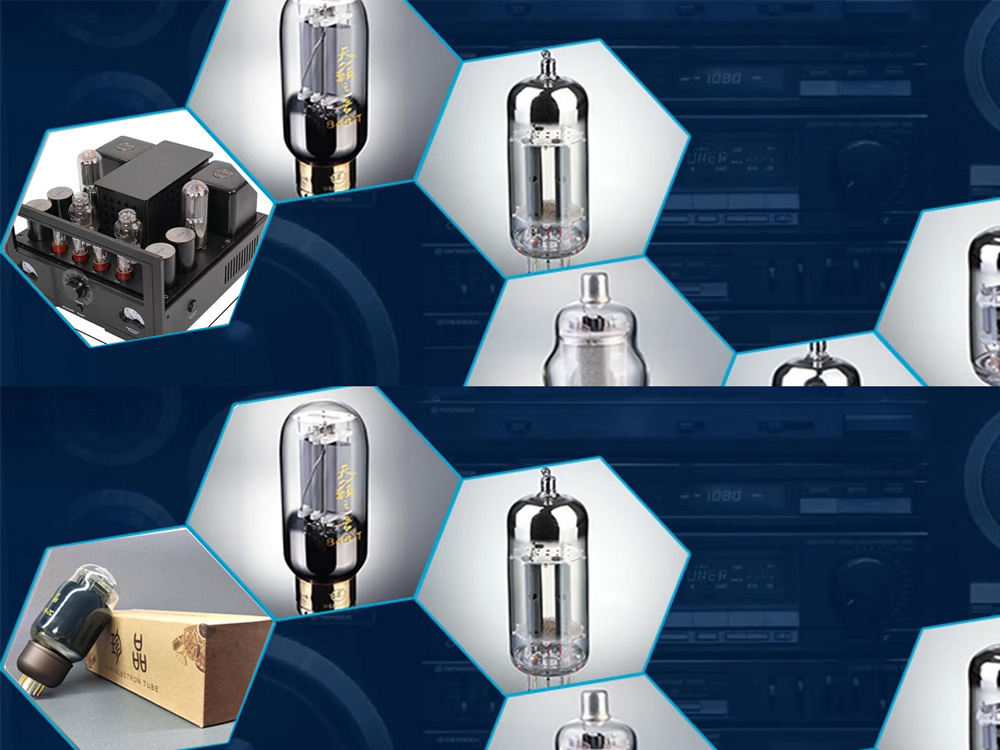
I. Structure of Vacuum Tubes
An electron tube is a device that utilizes discharge phenomena in vacuum or thin gas; therefore, it is also widely referred to as an “electrovacuum device.” It mainly consists of key components such as the cathode (electron emission source), the anode (electron collector), the grid (electron control electrode), core columns, and glass envelopes.
1. Other Structural Parts
Other parts refer to discrete structural accessories produced separately before assembly, including gallium components, anode parts, mica sheets, outer casings, etc.
2. Components Assembled from Multiple Parts
A component is an integrated structural unit made of two or more individual parts, such as assembled tube cores, beam shielding plates, etc.
3. Electronic Tube Finished Device
A complete device formed by assembling individual parts and integrated components into a functional unit, i.e., finished vacuum electron tubes.
II. Characteristics of Vacuum Tube Production
Compared with other industrial manufacturing sectors, vacuum tube production has distinct unique features.
(I) Wide Coverage of Cross-Disciplinary Technologies
- Vacuum Technology
- Glass Processing Technology
- Precision Mechanical Technology
- Fine Chemical Technology
- Radio Electronic Technology
- Metallurgical Technology
(II) Diverse Raw Material Categories
- Metal Materials
Tungsten, molybdenum, copper, nickel, iron, mercury, zirconium, titanium, etc.; alloy materials including tungsten alloys, mercury-nickel-manganese alloys, chrome copper, iron-nickel-cobalt alloys; surface composite processed materials: nickel plating, gold plating, silver plating, zirconium coating, turquoise coating, carbon coating. - Chemical Raw Materials
Ethanol, butyl acetate, sodium hydroxide, barium nitrate, acetone, nitrocellulose, etc. - Insulating Materials
Mica, industrial ceramics, bakelite, quartz glass, ordinary glass, etc. - Industrial Special Gases
Hydrogen, oxygen, nitrogen, natural gas, water vapor, purified compressed air, etc.
(III) Strict High-Cleanliness Vacuum Production Environment
Electrodes must maintain ultra-high cleanliness during manufacturing, which is the core prerequisite for stable product quality.
The cathode manufacturing and assembly workshops have strict dust-free standards. Operators must comply with full vacuum hygiene specifications: hand cleaning, uniform dust-free clothing, shoe changing, hairnet wearing, etc.
III. Purpose & Classification of Surface Coating for Vacuum Tube Parts
Mica sheets, electrodes and other core parts often require surface coating with functional substances after machining.
(1) Core Purposes of Surface Coating
- Modify surface radiation characteristics
- Adjust surface electron emission capability
- Change surface electrical conductivity
- Prevent corrosion of metal structural parts
- Adjust material thermal conductivity
- Other customized functional demands
Additionally, many parts are coated with getter materials to absorb residual gas inside tubes and maintain internal high vacuum during service.
(2) Coating Process Classification & Implementation Methods
- Mechanical Coating
a. Spraying; b. Drawing Coating; c. Impregnation Coating; d. Thermal Melting Spraying; e. Hot Melt Drawing (Hot Coating); f. Hot Melt Impregnation; g. Rolling Coating - Physical Coating
a. Cathode Sputtering; b. Vacuum Evaporation Coating - Chemical Coating
a. Chemical Solvent Coating; b. Oxidation Treatment Coating; c. Carbonization Coating - Electrochemical Coating
a. Electroplating; b. Electrophoretic Coating
IV. Cathode (Core Electron Emission Component)
The cathode is the most critical core part of a vacuum tube. The overall performance and service life of the entire tube depend entirely on cathode characteristics, so it is known as the “heart of electron tubes.”
Vacuum tubes rely on thermionic electron emission. Thermionic cathodes are divided into three main types: pure metal cathodes, thoriated tungsten cathodes, and oxide semiconductor cathodes.
1. Pure Metal Cathode
Represented by tungsten cathodes.
Advantages: High melting point, low evaporation rate, stable electron emission, strong resistance to positive ion bombardment, simple production process.
Disadvantages: Low electron emission efficiency.
Application: High-power oscillation tubes.
2. Thoriated Tungsten Cathode
Directly heated cathode with simple processing.
Disadvantages:
① High tungsten wire evaporation rate, limiting maximum operating temperature and emission efficiency;
② Extremely sensitive to residual gas contamination;
③ Thin filament structure, fragile and easy to break.
Dawn Electronic Tube Factory adopts carbonized thoriated tungsten cathodes, which optimize the above defects: higher emission efficiency, stable working performance, anti-positive ion bombardment, low gas sensitivity.
3. Semiconductor Oxide Cathode
Mainly oxide-coated cathodes.
Advantages: Low surface work function, far higher emission efficiency than tungsten/thoriated tungsten cathodes, high current density, low operating temperature.
Disadvantages: Complex manufacturing process, requiring independent filament heating assemblies; extremely strict requirements for ambient temperature, humidity and workshop cleanliness.
Application: Receiving amplifier tubes, low-power oscillation tubes.
V. Grid (Control Electrode)
The grid controls the flow of electrons inside the vacuum tube, generally made into grid or mesh structures. It is a key functional component with strict mechanical performance requirements:
- Sufficient mechanical strength: Deformation of grid-cathode spacing or grid wire pitch will drastically change tube transconductance and amplification factor;
- Stable vibration resistance: Avoid microphonics and noise under oscillation working conditions;
- Ultra-clean surface: Dirt contamination will induce grid reverse current and ionic leakage current.
VI. Anode (Electron Collector Electrode)
The anode collects electrons flowing from the cathode. High-speed electron bombardment and thermal radiation from cathode/grid cause the anode to operate under high-temperature conditions, so anode structural design and material selection are critical. The anode must bear sufficient power dissipation load.
Anode Heat Dissipation Types
- Natural Cooling
Used for receiving/amplifier tubes equipped with oxide cathodes. Limit: Maximum operating temperature controlled within 400–500°C to prevent cathode overheating failure. - Forced Cooling
Adopted by high-power tubes: water cooling, forced air cooling, oil cooling, plus matched auxiliary heat dissipation components.
VII. Lead-Out Wires
The vacuum tube is a hermetically sealed device but needs electrical connection with external circuits. Lead-out wires are hermetically sealed through the tube core rod, connecting internal electrodes to external circuits. Classifications:
- Three-section composite leads: nickel wire + DuPont wire + copper wire
- Two-section composite leads: tungsten/molybdenum rod + twisted copper wire + nickel DuPont wire
- Single-section leads: solid tungsten rod or molybdenum rod
- Special-shaped high-voltage leads
Designed for high voltage resistance and leakage suppression; grid/anode leads of some tube models are led out from the top or side of the glass envelope (e.g., KT88-Z).
VIII. Getters (Gas Absorbing Agents)
Vacuum tubes require an internal vacuum degree of at least 10⁻⁴ Pa for normal operation. Conventional vacuum pumping systems cannot sustain such high vacuum independently, so getters act as auxiliary internal vacuum pumps.
Core Functions
- Absorb residual gas remaining inside the tube after sealing;
- Capture gas released by internal components during long-term operation;
- Permanently maintain stable internal vacuum level.
Common Getter Materials
Barium film getter, barium-aluminum alloy getter, zirconium-aluminum alloy getter.
IX. Glass-Metal Hermetic Sealing
Glass-metal sealing is a core manufacturing process for vacuum tubes. Sealing joints must meet three standards:
- High mechanical structural strength;
- Zero air leakage, complete vacuum tightness;
- Excellent thermal shock stability.
Material matching rule: Select glass and metal with nearly consistent thermal expansion coefficients for direct sealing. This controls internal thermal stress of glass within safe limits and avoids glass cracking under temperature changes.
X. Vacuum Tube Assembly Process & Technical Requirements
Assembly refers to installing all tube parts into finished cores following standardized procedures: sequentially mount filaments, cathodes, grids, beam shielding plates, anodes and insulating mica components, then connect all electrodes to core rod lead-out wires.
Mandatory assembly specifications:
- Strict workshop cleanliness standards;
- Complete and intact electrode forming shape;
- Ultra-precise assembly dimensional tolerance;
- Firm locking and fixation of all auxiliary parts;
- Operator self-inspection & cross mutual inspection mechanism;
- Batch submission for dedicated quality inspection.
XI. Sealing & Exhaust Process Purposes
1. Tube Sealing
Integrate the assembled tube core with the outer glass envelope, reserving an exhaust tube connected to external vacuum pumping equipment.
2. Exhaust (Vacuum Pumping) Process
Apply specified filament voltage, anode/grid bias and high-frequency heating to metal components during pumping:
- Decompose and activate cathode emission materials;
- Extract gas adsorbed on part surfaces and gas trapped inside material structures;
- Eliminate outgassing risk during tube operation and lock stable internal vacuum.
XII. Aging Training Process Significance & Purposes
Aging treatment is secondary electrical performance conditioning for exhausted, cased vacuum tubes before delivery, to stabilize working parameters.
Core objectives:
- Complete full cathode activation, adjust electron emission capacity to standard range;
- Reduce leakage current between filament-cathode and all inter-electrode gaps, stabilize tube electrical parameters;
- Eliminate residual internal gas to further elevate vacuum degree.
XIII. Finished Product Testing & Inspection
100% full inspection is implemented immediately after tube production. All unqualified products are screened out to avoid outflow to the market.
Test Items
Filament current, anode current, grid current, transconductance, parameter symmetry, inter-electrode short-circuit insulation resistance, etc.
Complete Inspection Flow
- Workshop full 100% online testing;
- Qualified semi-finished products transferred to QA warehouse for aging storage;
- QA department conducts random sampling parameter re-inspection;
- Secondary sampling test after warehouse storage;
- Products with all qualified test indicators issued with finished product certificates and stored in finished goods warehouse.
XIV. Life Reliability Test & Special Environmental/Mechanical Tests
1. Service Life Test Definition
Operate vacuum tubes under rated standard working conditions until any electrical parameter drops below the qualified threshold. The total continuous working time is defined as tube service life.
Standard receiving tubes carry a guaranteed continuous service life of 500 hours.
Random batch sampling life testing is mandatory before factory delivery, to verify actual service life and validate the rationality of production processes & raw material selection.
2. Full Range Special Testing Items
Production Reliability Tests
Filament continuous operation test, glass-metal seal thermal stability test
Climate Environmental Tests
High & low temperature cycling test, constant humidity test, low-pressure high-altitude simulation test, glass thermal shock stability test, tube base/cap mechanical firmness test
Mechanical Strength Tests
- Vibration frequency fatigue test
- Mechanical impact resistance test
Factory Test Lab Note
Shuguang Electronic Tube Factory is the only manufacturer in China equipped with complete independent service life testing and special environmental/mechanical testing laboratories to guarantee consistent product quality.
Hi, this is a comment.
To get started with moderating, editing, and deleting comments, please visit the Comments screen in the dashboard.
Commenter avatars come from Gravatar.